
OSACO GROUP
Investigations Training Courses
Elevate Your Investigations and Interviewing Skills
If you are looking for effective, internationally recongised and trusted investigations training, you have come to the right place.
OSACO Group is trusted by the United Nations, INGO (International Non-Governmental Organisations) and corporate organisations to deliver investigations, training and capacity development.
We have undertaken investigations and training for over 100 humanitarian and developmental organisations globally.
Completion of our respected and internationally recognised training programmes enhances both your organisational credibility, and its competency. It is proof to partners, employees, clients, donors and investors alike that your organisation has the essential systems, policies and resources to carry out workplace investigations effectively.

Certified Training Programme for Misconduct Investigations – Four Days
Enhance your investigation skills
OSACO’s Certified Training in Misconduct Investigations is a gold standard for investigative training, enabling investigators of all skill levels to enhance both their abilities and confidence to conduct thorough and effective workplace investigations.
An Investment in Competence and Confidence
OSACO’s Certified Training programme covers the principles, skills and techniques conducive to effective investigative interviews. The training can focus on general workplace-related investigations, or offer a more specific focus on the critical areas of SEAH, or fraud and corruption.
Whichever focus you choose, you are guaranteed the highest quality investigative training available, delivered by international training and investigation experts.
Contact us to learn more about Certified Training for your Organisation.
- Principles that underpin effective investigations
- Roles and responsibilities of investigation team members
- The phases of an investigation
- How to write a solid investigation plan
- How to gather and analyse evidence
- Understanding and applying the PEACE interview model
- How to apply a trauma-informed lens to investigative interviews
- How to conduct remote investigations and what to consider
- How to structure and write a high-quality investigation report
- And other practical and hand-on tips from our experienced investigators.
- Training is tailored to your specific operating environments, needs and expectations.
- OSACO performs a pre-programme training needs assessment to ensure our training offering perfectly matches the requirements of your participants.
- Training materials are regularly updated to ensure they are current and relevant.
- OSACO provides an additional six months of mentoring and coaching to support the programme’s in-practice application in your workplace.
- OSACO training serves as strong evidence of competency for recruitment to, or applications for, roles that require investigative skills.
- Individual participants and organisations can become OSACO-certified following completion of all levels, and re-certified after 24 months.
- OSACO can deliver training in any country not currently engaged in war or armed conflict, and can deliver online.
- We can deliver training in English and several other languages; please enquire
- Individuals aspiring to become workplace misconduct investigators
- Existing investigators seeking professional development
- Humanitarian and development professionals looking to deepen their knowledge of investigations (NGOs, UN Agencies etc.)
- Lawyers or Human Resources professionals charged with conducting workplace investigations
- Government department employees who need to ethically investigate suspected misuse of access to service
Investigative Interviewing – Two Days
Enhance your investigative interviewing skills –
PEACE plus people-centred approaches
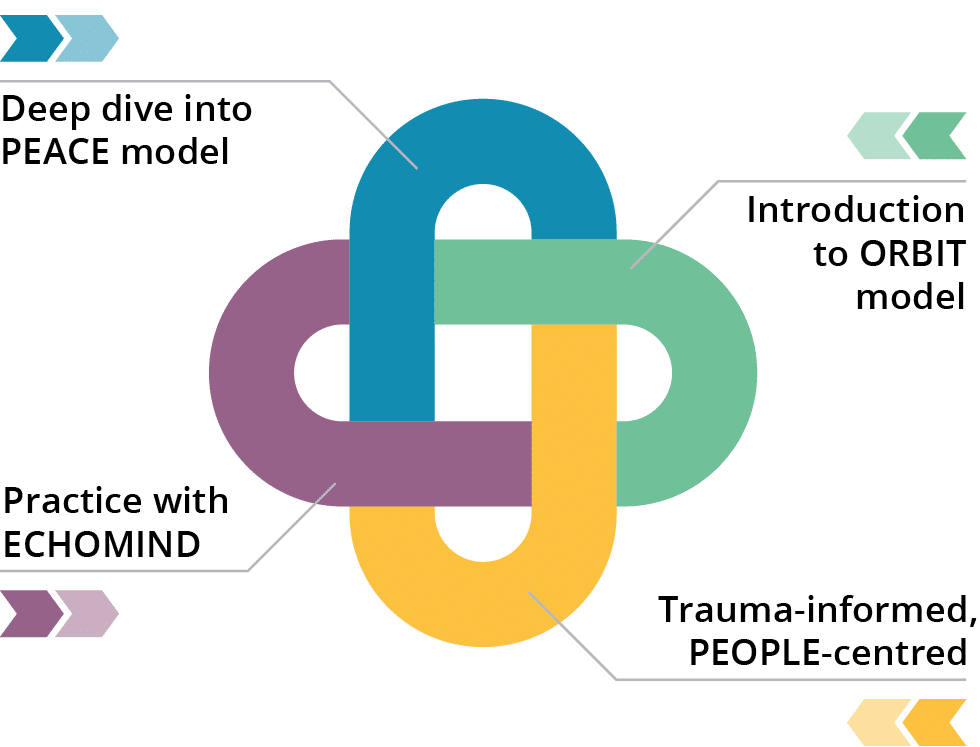
This training offers both a refresher and an in-depth exploration of every aspect of the PEACE model, with special focus on the Planning / Preparation, Engaging / Explaining and Account stages.
As well as learning how to ask pertinent questions, this course will provide you with an understanding of how to ask those questions in ways that build rapport with your interviewee and create an environment for quality disclosures.
It also integrates an understanding of the ways in which trauma and violence affect recall, memory and testimony, showing participants how to create safe, supportive interview environments that encourage accurate disclosures and minimise re-traumatisation.
Delivered by expert trainers and integrating practical exercises and role plays, this intensive course will show participants how to create safer, more supportive interview environments that encourage accurate disclosures and ensure fair, ethical and effective interviews.
Contact us to learn more about Investigative Interview Training Events or register your name to waitlists here: International Events; New Zealand Events
- Planning and Preparation, including the role of investigation managers; setting clear objectives; identifying and mitigating risks; and aligning strategies.
- Practical techniques for managing the Engaging / Explaining and Account stages of the PEACE model.
- Understanding how memory functions and how trauma and violence can affect recall and testimony.
- Consideration of how question design and phrasing can foster co-operation and encourage safer and more accurate disclosure.
- An introduction to the ORBIT interviewing model and its rapport-building approach to improving interview outcomes.
- Application of best-practice techniques across diverse investigative settings.
- How EchoMind, OSACO Group’s new interactive AI-based platform, can enhance interview skill and confidence by enabling repeatable interview practice with lifelike avatars.
- Experienced investigators and investigation managers seeking a refresher or deep dive into the PEACE model.
- Practitioners newer to face-to-face interviewing
- Investigators seeking effective and adaptive interview strategies suitable for different cultural contexts and communication norms.
P - Planning and Preparation
Thorough and considered preparation is foundational to effective interviewing.
Planning involves intentional thinking about who we are interviewing, why, and the best approach. And it’s where - particularly in safeguarding or workplace harassment investigations - survivor-centred and trauma-informed practice is either built-in, or missed entirely.
Many interviewees require special consideration: vulnerable witnesses (including children); survivors of sexual exploitation, abuse or harassment; people with physical, mental or learning challenges; and those facing language or cultural barriers. Failing to plan properly is failing them and, potentially, the investigation.
Effective preparation also includes further practical considerations, such as risk and safety, interview needs and interview team composition, as well as the actual physical interview environment.
E - Engage and Explain
In the PEACE model, Engage and Explain (E&E) sets the tone for the entire interview.
Being interviewed - whether as a survivor, a witness, or the subject of a complaint - is rarely easy. Those first moments often involve anxiety, uncertainty and strong emotions, which may present in a variety of human responses, including hesitation, guardedness, or resistance.
Engagement begins with the basics, done well: introducing yourself and anyone else present (co-investigators, interpreters), explaining roles, and clearly outlining the process.
We set expectations, answer questions, respond to concerns, and provide reassurance. This is where rapport is built and trust begins to form, through demonstration of a co-operative attitude, empathy, respect and with awareness of our own biases.
This phase is also where kinesics matters. Our tone, body language, patience and presence all create an impression. By taking time and care, we build rapport, put the interviewee at ease, and create the conditions for meaningful engagement.
‘A’ - Account
The Account (A) phase of the PEACE model is where we invite the interviewee to share their experience in their own words; this requires interviewers to create the conditions in which accurate, meaningful accounts can safely emerge.
To support the free recall phase, it is good practice to:
- Give clear, supportive instructions: encourage the interviewee to share everything they remember, in any order, without self-editing, even if details feel unclear or unimportant
- Use demonstration for more detail: model the expected level of detail by describing a neutral object or experience
- Apply the funnel approach: start with open-ended questions, then move to probes (who, what, where, when, how) that focus on circumstances and processes.
A trauma-informed Account also rests on core principles:
- Ask one question at a time
- Avoid closed and leading questions
- Minimise “why” questions
- Use clear, neutral language
- Allow silence and processing time
- Be attentive to non-verbal cues.
‘C’ – Closure
The closing stage needs to be just as complete and effective as any other; it should have been considered in the initial planning phase.
This stage involves summarising the interviewee’s account of what happened and verifying that everything that needs to be discussed or asked by either party, has been covered.
Effective closure should:
- review and summarise the information given by the interviewee, to ensure there is mutual understanding about what they have said
- verify that all questions have been asked and points clarified, and that the interviewee has been given the opportunity to provide all the information that they are able to
- offer the interviewee the opportunity to ask questions or receive clarification
- explain what next steps will be.
‘E’ – Evaluation
This phase of review applies both to the information disclosed, and the efficacy of the interview process itself.
It is vital not to skim over the evaluation process as objective review and learning can impact next actions in this investigation, and also how future interviews are undertaken.
Evaluation also enables the interviewer to reflect on their abilities, confidence and techniques and identify any opportunities for improvement.
- was the interview successful in terms of quality and comprehensiveness of information shared by the interviewee?
- was the interaction deemed successful in terms of quality of engagement?
- how does this information disclosed affect the investigation?
- could anything have been done differently, in order to better deliver in terms of information relevant to the investigation, as well as the interview experience?
This two-day equivalent course will soon be available online, to complete at your own pace and your own place. It will include access to EchoMind to apply and practice the interview techniques you learn.
Open Attendance Investigations’ Training Events – Two-Four Days
Our open investigations trainings enable individual registration to investigations courses, rather than requiring a home organisation to host its own training.
These events will have differing foci – investigations; investigative interviewing; investigating SEAH; investigation fraud and corruption etc – and take place in various international locations and languages.
Visit our Open Training page to see what open training events are currently available, or register your name to waitlists here:International Events; New Zealand Events
Proven results
We regularly receive extremely positive feedback from training participants. Results from our latest training evaluation analysis showed the following average results:

Global Head of Training
OSACO Group’s Global Head of Training is Claudia Zehl
OSACO Group’s Global Head of Training, Claudia Zehl, has worked for over 15 years in humanitarian responses and international development.
Claudia has utilised applied or shared her extensive experience in PSEAH and safeguarding in capacity development, training, investigations, mediation and facilitation.
Gold standard investigative training
Proven competence with ongoing support and global credibility.
All conversations with us are considered confidential, handled with discretion and, of course, without any obligation.